The UK Data Service are offering a free webinar for undergraduates and postgraduates who are using secondary data analysis in their research projects.
The free webinar takes place on 26th May 2020, but if you can’t attend then, it will be recorded and uploaded to YouTube afterwards.
Organised by the UK Data Service, the webinar will take you through the research process of a secondary analysis project, which includes an overview of the methodological, ethical, and procedural issues.
If you are a postgraduate looking for a project to do this summer that doesn’t involve face-to-face contact, or an undergraduate student trying to evaluate options for next year’s dissertation, this webinar will give you options to ensure you get valuable research experience during your degree.
This is an introductory webinar which assumes no prior experience of using archived data.
The following sessions will be sponsored and co-sponsored by the Social and Cultural Geography Research Group for the RGS-IBG annual conference 2020, 1st – 4th September.
Should you wish to submit an abstract for any of the sessions below, please contact the organisers directly.
Non-representational geographies: approaches, methods and practices
This session offers a space for discussion of existing and emerging research exploring non-representational geographies. Non-representational theories provide a springboard for exploring the affective geographies of a multitude of phenomena from ageing, to nationalism and geopolitics, to name but a few. Various approaches, methods and theoretical lineages reflect and infuse the diversity of non-representational geographies, bringing together a concern for how places, subjectivities and identities are enacted, felt and mediated. The session presents an opportunity to traverse and reconsider the ‘borders’ within social and cultural geography with respect to non-representational theories. It provides a space to take stock of the development of the non-representational and associated thinking within and between subdisciplines. As well as research drawing on the established corpus of non-representational research, we are particularly interested in recent and innovative engagements with non-representational theories.
Topics in this session might include, but are not limited to:
– How might those engaged with non-representational theories learn from other innovative frontiers within social and cultural geography and vice versa?
– What non-representational geographies are emerging within the subdisciplines of geography, the arts and wider social sciences?
– How has social and cultural geography sought to understand the ways in which places, subjectivities and identities are enacted, felt and mediated? How can this be furthered?
– How are different bodies part of the nature of affective places/non-representational geographies?
– How are/might scholars engage methodologically with non-representational theories?
We are interested in engaging with perspectives from academics at all career stages.
Navigating, disrupting and re-working the borders of multiple citizenships
In turbulent and precarious times, the
promise of national citizenship is desirable yet often elusive (Bhrabat, 2019).
This is particularly true for ‘non-citizens’, such as those seeking asylum
(Könönen, 2018) where limits on citizenship have violent consequences. However,
formal citizenship is also unstable, seen through enduring exclusions for those
who are nominally, but differentially, ‘included’ (Erel, Reynolds, &
Kaptani, 2018) and through the uneven space-times of citizenship ( Brexit, the
Hostile Environment and Windrush) (Wardle & Obermuller, 2019). Beyond
formal citizenship, there exists an array of ‘acts’ of citizenship that by-pass
or contest legal membership (Isin, 2008). Work on post-national identities
(Soysal, 2002), translocal activism (Nagel & Staeheli, 2008), everyday
multiculturalism (Clayton, 2009), emotional citizenry (Askins, 2016) and sonic
citizenship (McMahon, 2017) all highlight everyday relational practices that
re-constitute borders of belonging. However, questions remain regarding the
continued salience of the promise of formal citizenship and the ways in which
contestations might continue to be ‘managed’ (Darling, 2017). Here, we look to
address the tensions and ambivalences (Ikizoglu Erensu, 2016) between partial,
uneven and (non-)citizenship and acts of citizenship that are practiced in
relation to, in spite of and against the prevailing ‘institutional order’
(Aradau et al., 2010).
We welcome papers that address a wide
range of experiences including migration and asylum, but also other practices
of belonging for those whom formal national membership is tentative, uneven and
precarious. We hope to attract work from
a diverse range of theoretical and methodological perspectives that relate (but
not limited) to:
Plastics are on the agenda. In
different contexts, in different ways, plastics have rapidly emerged as central
to environmental debates, politics and behaviours, as well as to academic and
technical work across a range of disciplines. This session seeks to encourage
expansive, critical and creative approaches to plastics and their geographies.
It seeks to emphasise how an awareness of geographical processes – and
geographical analyses – might enable us to grapple with the synthetic, sticky,
slippery characteristics of plastics. Yet, since plastics constitute, challenge
and percolate through more-than-human systems, at different spatial scales, the
session will also engender debate about the kinds of inter- and
trans-disciplinary scholarship required to address ‘plastic geographies’.
Drawing on recent (particularly feminist, queer and critical race)
theorisations of and responses to plastics, we are particularly interested in
the ways in which we (as a species, but also with nonhuman others) are
“(en)plasticized” or bound by a “plastic contract” that will threaten and
differentiate life for many centuries to come (Ghosh, 2019: 277). Despite
attempts, especially in the Minority Global North, to divest plastics and
render them ‘elsewhere’, plastics are no longer ‘outside’: they constitute the
‘substrate of advanced capitalism’ (Davis, 2015: 348). From decolonising
perspectives perhaps plastics have never been ‘outside’ – made up of ancient
more-than-human-kin to be cared for, carefully (cf. Libroin and the CLEAR
Laboratory). Looking specifically at humans, we already know that the
pernicious effects of living or working with plastics, in particular times and
places, are patterned by (young) age, gender, race and class (Huang, 2017).
Thus, a greater attentiveness to the workings of plastics does not simply
require new forms of collaboration across disciplines but also new forms of
interdisciplinary critique and experimentation. Whilst not, ultimately,
assuming that all plastics are ‘bad’ (Libroin, 2015), this session nevertheless
seeks to draw together empirical, critical, experimental, applied (and more)
research that can respond to the machinations of plastic geographies.
Examples of topics to be covered within the
session:
Circulations
of plastic(s) through social, ecological, hydrological and technological
systems
Children’s
geographies and plastic childhoods
Household
geographies and flows of plastic(s) through everyday practices
Everyday
attachments to, aspirations about and/or nostalgia for, plastics
Material
geographical analysis of stocks and flows of plastics through everyday lives,
homes, communities, societies
The
role of plastic in food waste and food safety
Connections
to health and hygiene (eg., menstrual health, hospitals and healthcare, indoor
ecologies)
Interdisciplinary
work linking ‘polluting practices’ to water and sanitation systems
Analysis
linking cars and mobilities to plastic in aquatic systems
Links
to emerging research areas of ‘toxic geographies’
Indigenous
and anticolonial perspectives on plastics
Feminist
and intersectional perspectives on plastics
Political
and economic geographies (e.g., firms, commodities/commodification)
Multi-,
inter- and/or trans-disciplinary research invoking co-produced solutions
Examples
of research/policy praxis to invoke meaningful change
Critical
analyses of contemporary discourses about plastics, across geographical and
social contexts
Any
surprising, interesting, and evocative connecting themes we haven’t identified
This call for presentations is linked
to the Leverhulme funded ‘Plastic Childhoods’ led by Prof Peter Kraftl
(University of Birmingham) and the EPSRC funded RE3 (Rethinking Resources and
Recycling) ‘Plastic Hygiene’ workpackage led by Dr Alison Browne (University of
Manchester).
We particularly encourage Masters, PhD
and ECR students and researchers from diverse disciplinary backgrounds to
participate in the sessions.
References
Davis, H., 2015. Life & death in the Anthropocene: A short history
of plastic. Art in the anthropocene: Encounters among aesthetics, politics,
environments and epistemologies, pp.347-358.
Ghosh, R., 2019. Plastic Literature. University of Toronto Quarterly,
88(2), pp.277-291.
Huang, M.N., 2017. Ecologies of entanglement in the great pacific
garbage patch. Journal of Asian American Studies, 20(1),
pp.95-117.
Libroin, M. 2015. Redefining pollution and action: The matter of
plastics. Journal of Material Culture, 21(1),
87-110
From identity to identification: vernacularization of Asian borders
Dr. Po-Yi Hung, Associate Professor, National Taiwan University, poyihung@ntu.edu.tw
Dr. June Wang, Associate Professor, City University of Hong Kong, june.wang@cityu.edu.hk
Borders cannot be
reduced to “a singular focus on political borders and their related social
boundaries”, but a dynamic, “bounding processes involved in all types of
categorization (Jones, 2009: 184), which “metaphorically and physically shape
the ways we understand the world around us (Jones, 2010: 266).” The renewed
approach for border studies pushed scholars to re-orient attentions to the
non-state actors at the scale of people’s everyday lives (Jones and Johnson,
2014), or what Cooper et al (2004) call the “vernacularization of borders”.
The approach of
“vernacularization of borders” is of particular value to our understand of
Asian borders, where the everyday practices of bordering is shadowed by the
geopolitical tensions among countries and regions, from North Korea and South
Korea, Taiwan, Hong Kong, to China and
India. This session aims to relocate Asian borders in everyday identification,
investigating the process of articulating, negotiating, and re-defining
territorial identities that move across categories of ethnicity, religion,
citizenship, law, nationalism, gender, and indigeneity. How different human and
nonhuman actants, from tourists, farmers, dealers, smugglers, makers,
agricultural and medical materials, encounter to do the border work and in
return be shaped by meanings and effects of borders and bordering of the world.
Tentative topics
include:
Political, social, cultural, religious performance of
borders
Transborder communities, regional identity and
placemaking
Border governance and institutions
Identity politics, “United in Diversity” –
internal bordering of societies
national and regional identity,
References
Cooper, A., Perkins, C. and Rumford, C. 2014. “The vernacularization of borders.” In Jones, R. and Johnson, C. editors. Placing the Border in Everyday Life. Border Regions Series. Ashgate: Burlington. Pp. 15-32.
Jones R. and Johnson, C. 2016. “Border militarization and the re-articulation of sovereignty.” Transactions of the Institute of British Geographers. 41(2): 187-200.
Jones, R. 2009.“Categories, borders, and boundaries.” Progress in Human Geography. 33(2): 174-189.
Schaffter, M., Fall, J. and Debarbieux, B. 2009. “Unbounded boundary studies and collapsed categories: rethinking spatial objects. Progress in Human Geography. 34(2): 254-262.
Changing purposes and practices of the library as border
Dr Rianne van Melik, Radboud University Nijmegen, The Netherlands r.vanmelik@fm.ru.nl
Libraries are not merely information
infrastructures facilitating the exchange and formation of public opinion, but
also social infrastructures providing access to social networks and capital
(Aabø & Audunson, 2012). Therefore, Klinenberg (2018) defines them as
‘palaces for the people’, which have not become obsolete or irrelevant in the
current digitalised society. Instead, they are often neglected, starved for
resources and overburdened by visitors and activities. In response decreasing subsidies
and membership, the library landscape is constantly changing. Providing access
to books and information becomes seemingly less important, while the offer of ‘non-book-based services’ is growing including
creative and movement-based activities like yoga and fitness. Consequently,
a number of changing purposes and practices of the library can be observed. For
example, large public libraries in the Netherlands become new urban ‘hotspots’,
often part of multifunctional flagship projects. In contrast, smaller towns struggle with keeping their
libraries open. Solutions are sought in turning libraries into social and care
spaces. These examples show how libraries are literally opened up; from single-purpose,
‘closed’ systems characterised by books and silence to open spaces where social
and physical boundaries are not ordinarily expected. This session examines
libraries as inclusive spaces, characterised as borders rather than by
boundaries (Sennett, 2017). However, the encounter between different users of
library spaces can ignite both unexpected conversations and conflict.
We invite contributors to submit
abstracts on relevant themes, including, but not limited to:
Boundaries of libraries; libraries as borders
Libraries as care and community spaces
Libraries as catalyst of urban regeneration
Libraries as liminal spaces
Changing librarianship and library practices
Libraries as sites of inclusion and exclusion
If
you would like to participate, please send an abstract of between 200-250 words
to dr. Rianne van Melik, Radboud University Nijmegen, the Netherlands (r.vanmelik@fm.ru.nl) by 31st January 2020.
References
Aabø, S. & R.
Audunson (2012), Use of library space and the library as space. Library and Information Science Research,
34(2), 138-149.
Klinenberg, E.
(2018), Palaces for the People: How to Built a
More Equal and United Society. London: The Bodley Head.
Sennett, R. (2017), The Public Realm. Chapter 32 in: Hall, S. & R. Burdett (Eds.), The Sage Handbook for the 21st Century. London: Sage.
Legacies of austerity:
What, who, and when does it leave behind?
Over a decade
has passed since the 2008 financial crisis, but the socio-spatial consequences
of austerity still haunt contemporary spaces of everyday life. The narrative of
austerity shifted from austerity as crisis ‘measure’ to governing ‘ideology’.
What does this transformation mean for social, cultural and economic
geographies? How does this shift affect austerity’s spatial outcomes, reception
and resistance? Does austerity still hold as an explanatory factor or are we
facing poverty by other means? In two sessions, we examine how austerity’s
legacies settle in everyday life and shape everyday geographies.
In the first
session, creative output made by, with, and for groups living with austerity
explore its legacies. Accompanied by 5-minute talks, these forms of
co-production explore how austerity has taken root in everyday lives and
experiences.
During the
second session, 15-minute conference papers address the legacies of austerity,
including ‘austerity events’ and ‘austerity ideologies’. How did austerity
reassemble everyday life and transform social relations? This session invites
projects that assess austerity’s embedded legacies, now and into the future.
Together, these sessions explore how the legacies of austerity become embedded in the ‘new normal, and how the future is imagined in response to, or in spite of, these legacies.
We know that a plethora of
cross-cutting identities exist within our discipline, and that these may
present an opportunity to produce a more inclusive and representative
Geography, but they also present tensions at the individual and collective
levels.
Porous disciplinary borders facilitate
intellectual mobilities across, within, through and beyond geography. This
gains greater social and cultural significance when we consider who stays
within geography, and who leaves. Geography welcomes doctoral students from
diverse academic backgrounds, and simultaneously trains geographers who go on
to reside in alternative academic fields. Whilst this can lead to the kind of
inter/multi-disciplinarily working required to tackle complex global
challenges, it may inevitably affect individual academic identities. In
addition, sub-disciplinary branding is increasing within geography. As
issue-related branding becomes more commonplace (nuclear geographer, climate
change geographer), how is this creating fresh silos or hybridising our
academic identities?
What does it mean to be a geographer?
How do we relate to each other as geographers?
This session aims to explore
individual experiences of negotiating geography’s internal and external borders
as an academic through autoethnographic accounts. In doing so we particularly
aim to illuminate the stories of hidden, dispersed or unruly geographers within
the neoliberal academy.
The RGS-IBG Social and Cultural Geography Research Group (SCGRG) would like to invite expressions of interest for sponsored sessions for the RGS-IBG 2020 Annual Conference, which will take place in London from Tuesday 1 to Friday 4 September 2020.
The theme for the 2020 Annual
Conference, chaired by Professor Uma Kothari, is borders, borderlands
and bordering.
SCGRG is keen to sponsor sessions that directly
relate to the conference theme but also those sessions that engage with broader
issues of contemporary concern to social and cultural geographers.
When designing your session proposals please
take note of the following:
A session cannot occupy more than two timeslots on the conference
programme unless this has been pre-arranged with the RGS team. Those seeking
more than one timeslot should consider co-sponsorship (i.e. splitting
sponsorship so as to have a sponsor for each time slot).
Each attendee can only make two substantive contributions to the
conference programme (e.g. as paper presenter, panel member, discussant). A
substantive contribution is defined as one where the individual concerned needs
to be present in the session room, and so can include session organiser if
attendance is necessary. For individuals proposing multiple co-authored papers,
an alternative presenter must be clearly nominated at the time of submitting
the session/paper.
You can find the RGS guidelines for session proposals at:
You are welcome to propose joint sessions to be
co-sponsored by another research group.
Please send expressions of interest including the
below information by Friday 3rd January at 6pm. We
will inform applicants of the outcome by 10th January.
(i) Title of session;
(ii) Name of Co-sponsoring groups, if applicable
(iii) Name and Contact Details for Session
Convenors
(iv) Abstract, outlining scope of session – 200 words
max.
(v) Number of session timeslots that are sought –
please note: this year a session may not occupy more than 2 time slots
unless this has been pre-agreed with the RGS.
(vi) Indication of session format
Proposals for, or questions
about, SCGRG sponsored sessions should be sent to Will Andrews w.andrews@bangor.ac.uk
Studies exploring more-than-human relations in the city and understandings of the spatial in visual art win SCGRG dissertation prize
Charles Couve of the University of Manchester is our 2019 Winner for his dissertation entitled More-than-human Manchester: Recombinance, Auras, and Dialectics in the Edges of Modernity. The committee found this a fascinating and original study. Written in rich and engaging prose, they were impressed with its deft handling of complex ideas from a wide-ranging literature, and its deep, nuanced analysis of the city. They very much enjoyed the risks it took in style, method, and form, including its innovative use of creative methods to vividly explore the ‘excess’ of more-than-human relations. All felt that this was an outstanding example of cultural geographical work that demonstrates some exciting possibilities within an undergraduate research project.
William Silver of Durham University is our 2019 Runner-Up for his dissertation entitled Gordon Matta-Clark’s slices through space: artwork towards a critical understanding of the spatial. The committee were impressed with this engaging and original piece, which showed nuanced engagement with complex theoretical ideas and interesting experiments with form in its writing. They praised its incisive use of literature from across art history and geography and its fluid prose that made the piece a joy to read. An impressive piece of work that gives valuable insight into applications of cultural geographical thinking to art worlds in an undergraduate project.
The winner has received a prize of £100.
Both have also been given a one-year free subscription to the journal Social
& Cultural Geography courtesy of Taylor & Francis.
In total we received 19 submissions for the prize this year. These spanned the breadth of social and cultural geography interests and we look forward to continuing with the prize in 2020.
We are writing as chairs of the Gender and Feminist Geographies Research Group (GFGRG) and the Developing Areas Research Group (DARG) of the Royal Geographical Society (with IBG) (RGS-IBG). Currently, we are working together to improve support for those in academia with caring responsibilities.
The first strand of this work involves developing best practice guidelines for better supporting the research projects and fieldwork of those with care responsibilities. A second strand involves understanding and addressing the challenges of early career researchers taking parental or adoption leave. As part of this work, we are asking for your help in two ways. First, please could you let us know your own experiences of managing the parental/adoption leave of early career researchers and researchers funded by external/project grants, for example in terms of the impacts this has on research projects or on the intellectual work of the department? We are particularly interested to hear if the practices and policies of different funders have affected your ability to manage parental/adoption leave for staff. Second, please could you share the attached survey with your research staff (post doctoral researchers or any other contract researchers), so we can let them know about our work and ensure their input?
More information about this work is on our websites and will be presented at the 2019 RGS-IBG Annual Conference, London (for example, at our respective AGMs). However, if you have any questions please contact Professor Rosie Cox (r.cox@bbk.ac.uk) or Dr Jessica Hope (jessica.hope@bristol.ac.uk) directly.
The 2019 AGM of the Social and Cultural Geography Research Group (SCGRG) will take place at the RGS-IBG Annual Conference in London on Friday 30th August at 13:10 (Venue forthcoming). All are welcome to attend.
We have six vacancies for Committee positions as current post-holders complete their terms of office:
Chair
This post is a three-year term (in the first instance) and the role involves coordination of the group’s activities. Each year the chair prepares the annual report with the Secretary and the Treasurer, and provides an interim report at the AGM in August/September. The Chair normally attends the RGS-IBG Research Groups Committee at the RGS, normally in October and March. The chair will usually be involved in SCGRG’s wider committee activities i.e. part of the judging panel for our undergraduate dissertation prize.
Education Officer
This post is a three-year term (in the first instance) and the role involves leading the research group’s education-related activities. The education officer will liaise with the RHED officer of the RGS-IBG, and other research groups where appropriate, to coordinate the development of education and outreach events and resources. The education officer will also liaise with the Early career and mentoring Officer to assist with the development of events, resources, and networks to support members. The education officer would usually be involved in SCGRG’s wider committee activities i.e. part of the judging panel for our undergraduate dissertation prize.
Conference Officer
This post is a key and important role for the group. The conference officer leads the coordination the group’s sponsorship and organisation of sessions at the RGS-IBG Annual Conference each year and other events and activities. The role involves compiling call for sessions proposals, liaising with session proposers, and organising the vote on the proposals by the committee. The conference officer would usually be involved in SCGRG’s wider committee activities i.e. part of the judging panel for our undergraduate dissertation prize.
Ordinary Committee Member (x 1)
This post is a three-year term (in the first instance). While without specific responsibilities, ordinary committee members would usually be involved in the SCGRG’s wider committee activities i.e. part of the judging panel for our undergraduate dissertation prize. Ordinary committee members may also be asked to provide support for named roles.
Postgraduate Representatives (x 2)
This post is a one-year term (in the first instance) and the role involves liaising with the RGS-IBG Postgraduate Forum, engaging with postgraduate issues through our SCGRG postgraduate blog and working with our other postgraduate representative(s) on related events and activities. The PG representative would usually be involved in SCGRG’s wider committee activities, i.e. part of the judging panel for our undergraduate dissertation prize.
Nominations for successors (who must be a Fellow or Postgraduate Fellow of the RGS-IBG) are now open. Nominations must be in writing to the Chair (Prof. Harriet Hawkins – Harriet.Hawkins@rhul.ac.uk) and Secretary (Richard Scriven – r.scriven@umail.ucc.ie) with the name of two nominators (these need not be Fellows of the RGS-IBG or existing committee members). The deadline for nominations is Friday 23rd August 2019. The elections will be conducted at the AGM itself.
Further opportunities to be elected to a named role or as an ordinary committee member may become available during the AGM itself. We’ll also be discussing different ways that our wider membership can get involved with SCGRG.
If you have any questions about any of the above posts or about SCGRG more broadly, please e-mail Harriet and Richard.
The SCGRG offers an annual prize of £100 for the best undergraduate dissertation in Social and Cultural Geography. We also announce a runner-up prize. Both prize-winners receive a year’s personal subscription to the journal Social & Cultural Geography published by Taylor & Francis.
Nominated
dissertations should be: an outstanding theoretical and/or empirical piece of
work; usually approx.10,000 words in length; submitted for formal assessment in
the preceding academic year to a UK Higher Education Institution for a BA/BSc
level degree programme in geography; written in English. We are looking to
reward both excellent scholarship and innovation in the study of social and cultural
geography (please see the SCGRG mission statement for our definition of what is
considered social and cultural geography). Please note that a department may
not submit more than one entry and nominated dissertations should not be
submitted for consideration for any other RGS-IBG prizes. Nominations are
requested from the Head of Department or Dissertation Convenor.
All dissertations
should be submitted as a single pdf file with a post-September email and
contact address for the student. Submissions should be emailed with ‘SCGRG
Dissertation prize submission’ as the subject header. For any further queries,
please contact the SCGRG dissertation convenor, Sofie Narbed (details below).
Submissions to: sofie.narbed@rhul.ac.uk (Sofie Narbed,
Dissertation Convenor, Royal Holloway, University of London)
Earth Photo — Building on the success of last year, and run in partnership with Forestry Commission England, Earth Photo aims to stimulate conversations about our world, its inhabitants and our treatment of both. It is open to everyone, whether they have a connection with the RGS-IBG or not.
Call for Entries: We are currently at the Call for Entries stage, with a deadline of 6 May. All photographs and films submitted must be relevant to at least one of the following four categories: PEOPLE, PLACE, NATURE and CHANGING FORESTS.
An expert panel will select around 50 works to be exhibited at the Royal Geographical Society (with IBG) from 6 July – 22 August 2019, before beginning a national tour of a number of Forestry Commission England forests. Awards include cash prizes, editorial opportunities facilitated by RGS-IBG and opportunities with Forestry Commission England. A number of artists will also be eligible for a Next Generation Award and a Short Film Award.
The award-winning photographer, Marissa Roth, will chair the selection panel. Marissa is a Fellow of RGS-IBG and was part of the Los Angeles Times team that won the Pulitzer Prize for the LA riots. She has also worked for Newsweek, The New York Times and has had countless exhibitions internationally.
We really appreciate your help in spreading the word. If you have any further queries please contact the Society’s Press Officer, Giulia Macgarr, at g.macgarr@rgs.org .
Careers From Development: Putting Critical Thinking into Action. A postgraduate careers event hosted by the Developing Areas Research Group
Friday 15 March 2019
9.00am-5.00pm
Royal Geographical Society (with IBG), 1 Kensington Gore, London
Careers events and resources in universities tend to offer an array of options for those looking to work in the corporate sector. However there is less information about careers that utilise the critical debates covered in development and social science courses. As a result, students who have developed a critical understanding in international development, social justice, environmental justice, migration, human rights and globalisation are left with few options of where to take this after university.
The event will provide a chance for students to listen to and network with experienced professionals who will talk about the challenges and realities of working in development-related careers. This event is the first of its kind, and we are excited to be hosting it on such a large scale. We have confirmed speakers from Amnesty International, DFID, Centre for Global Development, Global Giving, Switched On London, Banyak Films, The Guardian and more.
New to teaching in geography, earth and environmental sciences (GEES): Workshop for postgraduates
Monday 25 March 2019
10.00am-4.30pm
Royal Geographical Society (with IBG), 1 Kensington Gore, London
Join Dr Lynda Yorke (Bangor University) and Dr Simon Tate (Newcastle University Prof Anson Mackay (UCL), with Dr Hilary Geoghegan (University of Reading) and Professor Anson Mackay (UCL) for a one day workshop to explore issues postgraduates face when teaching in geography, earth and environmental science (GEES). The workshop offers practical advice and ideas for undergraduate teaching through an exploration of the GEES subject signature pedagogies; strategies for engaging, working with and offering feedback to a wide range of learners; an introduction to participatory teaching, teaching lab work and fieldwork; and discussion and reflection upon the role and contribution of teaching assistants in all these areas using case studies and group discussions.
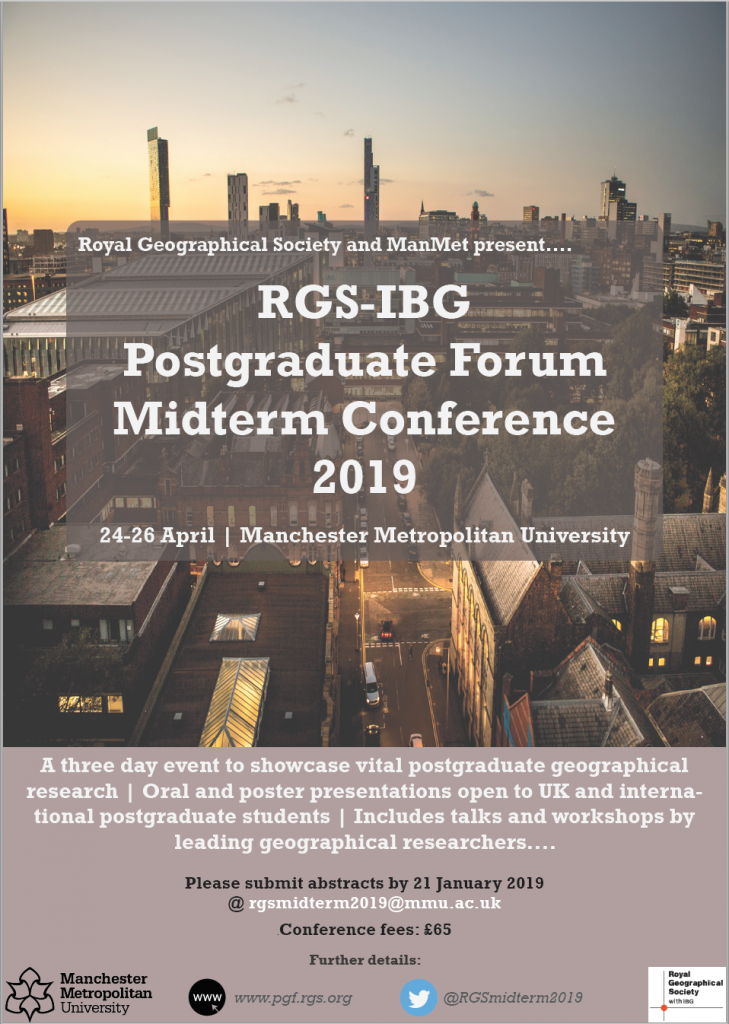
Nominations are now open for election to the committee of the Postgraduate Forum, with elections to be held at the AGM at the mid-term conference at Manchester Metropolitan University, 24-26 April. More information about the available roles and how to run for a position on the committee is available here: http://www.pgf.rgs.org/2019-pgf-elections. You can find out more about the Postgraduate Forum Mid-Term conference: http://www.pgf.rgs.org/rgs-postgraduate-mid-term-conference-2019/.
***
Jack Dangermond Award 2019
Applications for the Jack Dangermond Award 2019 are now open. The award provides support to attend the 2019 Esri UC in San Diego for undergraduates, postgraduates or early-career researchers who use the ArcGIS platform for teaching or research. The deadline for applications is Friday 26 April.
***
Applications now open for the Turing Enrichment scheme
The Turing Enrichment scheme offers students enrolled on a doctoral programme at a UK university an opportunity to boost their research project with a placement at the Turing for up to 12 months. Enrichment places are offered for 6, 9, or 12 months with start dates in October 2019 and January 2020. Places are based at the Institute headquarters at the British Library in London where students will continue their PhD in conjunction with their current supervisor, while enriching their research and making new collaborations during their time at the Institute.
Enrichment students may be eligible for a stipend top up of up to £5,500 as well as a travel allowance.
Applications should be made directly to the Turing by 11 March 2019.
Rodrigo Mendoza-Smith, University of Oxford (one of the Turing’s first enrichment students), had this to say about this experience: “The Enrichment programme at the Turing has been intellectually refreshing and stimulating. I find the daily interaction with Turing researchers the most valuable experience and I have also greatly benefited from weekly reading groups, seminars, masterclasses and meet-ups. ”
We are delighted to announce that our research group will be offering two bursaries for postgraduate students to attend and present a paper at the forthcoming RGS Postgraduate Mid-term conference at Manchester Metropolitan University, 24th-26th April 2019.
There are two bursaries to the value of £100 on offer this year, for any student whose research interests lie (broadly) within our research focus of social and cultural geography. It is a fantastic opportunity for postgraduate students to showcase their research, develop their presenting and network skills, hear talks and workshops from established academics within geography and make new friends.
To apply, you must be presenting a paper at the Mid-term conference to be eligible. On application for a bursary, please include the following and email your completed form to rgsmidterm2019@mmu.ac.uk.
Successful applicants will be required to write a short blog post about their experiences at the conference.
Application Form
Please email the completed form along with your abstract to rgsmidterm2019@mmu.ac.uk, by no later than Monday 18thFebruary.
Name of the research group for which a bursary is requested:
Name of applicant:
Institution:
Level and year of study:
Funding status:
Why are you applying for a bursary?
How is your application linked to the research group you are requesting support from? (No more than 250 words)