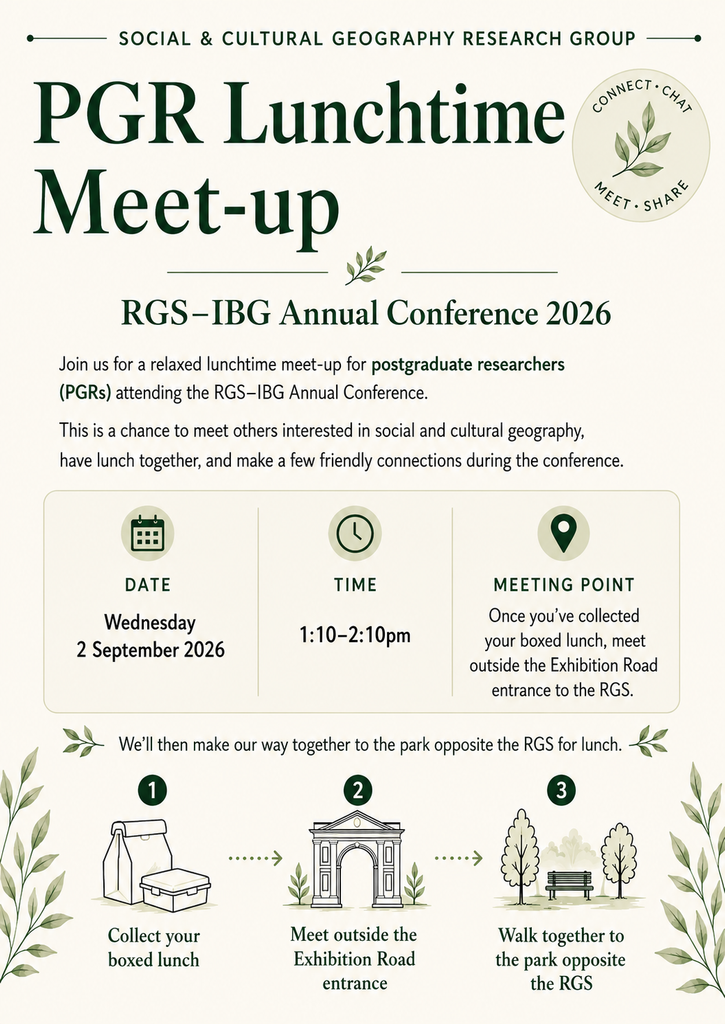
To respond to the conference theme of RGS-IBG annual conference, ‘geographies of inequality’, we are thrilled to announce that Social and Cultural Geography Research Group and Economic Geography Research Group are hosting an event in the SCGRG early career event series.
Please feel free to share it widely. We look forward to meeting many of you there. 🌱
SCGRG ✕ EGRG cohost event
Thinking beyond the standard research article: publishing commentary articles as an early career researcher
This event aims to provide practical guidance on how ECRs can publish their research through commentary articles. Geography journals increasingly provide space for short-form commentaries which intend to highlight emerging phenomena, reflect on disciplinary trends and outline areas for future research. This session invites Dr Liam Keenan to provide advice on how to approach commentaries, what to consider when developing them and how to align them with wider publication strategies. Beyond providing practical tips and takeaways, the session aims to empower ECRs with the confidence to make their voices heard through commentaries.
Dr Liam Keenan is an Assistant Professor in Economic Geography at the University of Nottingham. His research explores the financialization of pubs, the geographies of financial centres and the role of mergers and acquisitions (M&As) in concentrating corporate power throughout contemporary capitalism. Liam is also Chair of the RGS-IBG Economic Geography Research Group.
The Social & Cultural Geography Research Group is seeking an additional PGR rep to work alongside our existing rep. The term is one year. If you are interested, please complete the form below, and the committee will contact you with the outcome. Any questions, please email the committee Secretary, Sinéad O’Connor (sio13@aber.ac.uk).
Further info: Postgraduate (PG) Representative (1-year term, in the first instance)
This is one of two PG Rep roles, so you will work alongside another postgraduate to represent postgrads in social and cultural geography. The purpose of this role is primarily to offer guidance from a PG perspective within any SCGRG decision-making or event organising, including key committee activities such as Annual Conference session sponsorship. This role will also give you the opportunity to represent the needs and interests of current postgraduates, which may include organising PG-focused events and meetings, such as reading groups or work-in-progress groups. In this role, it is also a good idea to maintain links with the wider Geography postgraduate community through the RGS-IBG Postgraduate Forum.
We’re thrilled to announce the first event in this semester’s Early Career Event Series. Please feel free to share it widely. We look forward to meeting many of you there. 🌸
This event is designed for early career researchers preparing to publish their first article. We are pleased to invite Dr Rebecca Collins to share practical advice. The session will provide valuable insights and tips to help ECRs navigate the journey from manuscript to publication.
Rebecca (Beck) Collins is Deputy Head of the Division of Humanities, Cultures and Environment at the University of Chester. Her research examines young adults’ futures through the lenses of education and work, material culture, intergenerational relations, and relationships with nature. She is currently Chair of the Social and Cultural Geographies Research Group of the RGS and an editor of The Geographical Journal.
The RGS-IBG Social and Cultural Geography Research Group (SCGRG) would like to invite expressions of interest for sponsored sessions for the RGS-IBG 2026 Annual Conference, which will take place in London at the Society and Imperial College London, and online, from Tuesday 1 to Friday 4 September 2026.
The theme for the 2026 Annual Conference, chaired by Professor Peter Hopkins (Newcastle University, UK), is on the theme of Geographies of Inequalities: toward Just Places. You can find out more about the conference theme here: https://www.rgs.org/research/annual-international-conference/chairs-theme.
SCGRG is keen to sponsor sessions that directly relate to the conference theme, as well as make room for a wide range of other issues and topics. We welcome sessions which will be of wide significance and interest to social and cultural geographers, will meaningfully contribute to ongoing debates in social and cultural geography, and demonstrate substantive, methodological or theoretical novelty.
We are particularly interested in proposals exploring the social and cultural construction, reinforcement, and/or resistance of just and unjust places globally, as well as the socio-cultural effects when these places intersect. We encourage diverse epistemological and methodological approaches to social and/or cultural theorisation and problematisation of spaces of inequalities.
This discussion event explores some of the ways in which social and cultural geographers engage with policy-making, policy-makers, and practitioners in a wide range of fields, asking: What do academics do when they work on/with policy and policy-making? What have their experiences outside of academia been like? What impacts have resulted from this work?
In addition to our academic panellists, we’re delighted to be joined by non-academic geographers now in policy/practice roles who will talk about their transition from the academy into the world beyond. We’ll explore: What does research look like in those contexts? How did they find the transition? What support did they benefit from – or wish they had had?
Beyond the opportunities to learn directly from these conversations, SCGRG is working towards developing some ‘how to’ resources focused on the academia-policy-practice intersection. Look out for more on this in 2026.
Mel Nowicki is Associate Professor in Urban and Social Geography at Oxford Brookes University, and Visiting Reader in Urban Geography at King’s College London. For the past ten years she has been researching the lived experience of insecure housing, including homelessness, temporary accommodation, tiny housing and squatting. Since 2022 she and Professor Katherine Brickell (KCL) have been collaborating with policymakers and housing stakeholders, looking to improve temporary accommodation policy in England. Their book on the subject, Debt Trap Nation: Family Homelessness in a Failing Statewas published in October 2025.
Jo Cagney currently works at the Ministry of Housing, Communities and Local Government, leading the sponsorship of two Arm’s Length bodies, His Majesty’s Land Registry and the Leasehold Advisory Service. Since her Human Geography PhD she has spent over a decade in government in roles across housing policy, sponsorship, legislation, and strategic programme delivery.
Jonathan Darling is Professor of Human Geography at Durham University. His research focuses on the politics of asylum and urban migration. His book, Systems of Suffering: Dispersal and the Denial of Asylum (Pluto Press, 2022), explores the UK’s system of housing and support for asylum seekers and refugees. His work has centred on influencing public policy through providing evidence to Parliamentary committees and inquiries, working with migrants’ rights’ organisations and the Home Office, and extensive engagement with national and international media. For further details see: Professor Jonathan Darling – Durham University
Ealasaid Munro is a policy manager in the Broadcasting and Media team at Ofcom. A geographer by training, she worked in a variety of postdoc research positions in cultural policy research and film and television studies before taking up a lectureship in media and communications. Since joining Ofcom in 2019 Ealasaid worked on a variety of projects including managing Ofcom’s Channel 4 programme of work and conducting a qualitative deep dive into how the BBC serves people from working-class backgrounds. She is currently scoping Ofcom’s ‘Future of news’ research programme.
Liz Ackerley is Lead Analyst, in the Planning and Housing research team at Greater Manchester Combined Authority. She completed an ESRC-funded PhD at the University of Manchester focused on ‘Youth Activism in Times of Austerity’ and subsequently worked as a Research Associate on the ‘Austerity and Altered Lives’ project, also at the University of Manchester. She joined GMCA in March 2025.
Our next AGM takes place on Wednesday September 3rd, at 9am. We have exciting opportunities for new committee members to join our activities – if you are thinking of joining the research group, see details of committee roles below.
Social Media & Website Officer (two-year post)
The Social Media & Website Officer of SCGRG will:
Take the lead in posting content promoting SCGRG activities on the group’s social media channels.
Maintain the SCGRG website, ensuring key content (e.g. committee roles, annual conference information) is kept up to date.
Post content (on either social media and/or the website, as appropriate) generated by other committee members to promote group activities.
Support wider research group activities
Treasurer (three-year term)
The Treasurer is a member of the executive committee of the Research Group, alongside the Chair and Secretary. The main duties of the Treasurer are:
Keeps the accounts for the group
Ensures payments are made on behalf of the group
Compiles and submits the group’s annual financial reporting
Decision-making on committee activities as part of the Executive
Support and, where appropriate, co-lead research group activities
The Treasurer is expected to be a Fellow of the Royal Geographical Society (with IBG). Those who are interested in taking on a Research Group executive committee role (Chair, Secretary, Treasurer), but whose circumstances prevent them from taking up Society Fellowship, are invited to submit an expression of interest for a bursary to support Fellowship using the form available here: https://www.rgs.org/research/research-groups/resources-for-research-group-committees#executive-role-bursaries
There has been one internal expression of interest in this role.
Dissertation Prize Officer (two-year term)
The research group receives nominations for best undergraduate dissertation in the UK each summer, awarding a prize of £50 to the winner, and a one-year subscription to the journal Social and Cultural Geography to the winner and runner-up. The role of the dissertation prize officer is to:
Coordinate the judging and awarding of prizes for dissertations in line with the Research Group’s policy.
Update the RGS with details of winners
Liaise with the Treasurer to award prize money
Support wider research group activities
Conference Officer (two-year term)
The conference officer:
Coordinates the group’s activities at the RGS annual conference, including preparing the call for session sponsorship, organising sponsorship of sessions, leading the publicity of sponsored sessions, and managing Research Group Guest registration applications
Ensures conference information is made available on the research group website and social media
May also co-organise other events (e.g. workshops, seminars) for the group
The deadline for applications is 12pm,Tuesday 2nd September.
Our committee secretary will contact you with the Teams link in advance of the AGM, where nominations will take place.
Our AGM takes place on MS Teams on Wednesday September 3rd at 9am. Candidates are normally expected to attend. If this presents difficulty, please contact the Group Secretary, Sinéad O’Connor (sio13@aber.ac.uk).
The RGS-IBG Social and Cultural Geography Research Group (SCGRG) would like to invite expressions of interest for sponsored sessions for the RGS-IBG 2025 Annual Conference, which will take place in Birmingham and online from the evening of Tuesday 26th to Friday 29th August.
The theme for the 2025 Annual Conference, chaired by Professor Patricia Noxolo (University of Birmingham, UK), is ‘Geographies of Creativity/Creative Geographies’. You can find out more about the conference at: https://www.rgs.org/research/annual-international-conference
SCGRG is keen to sponsor sessions that directly relate to the conference theme, as well as make room for a wide range of other issues and topics. We welcome sessions which will be of wide significance and interest to social and cultural geographers, will meaningfully contribute to ongoing debates in social and cultural geography, and demonstrate substantive, methodological or theoretical novelty.
Please submit your expressions of interest for SCGRG sponsorship by 5pm GMT on Friday 31st January 2025 through: https://tinyurl.com/3nnwxnhv We will endeavour to inform applicants of the outcome by Monday 24th February 2025.
Questions about SCGRG sponsored sessions should be directed to the SCGRG conference officer Rishika Mukhopadhyay: r.mukhopadhyay@soton.ac.uk.
To mark the 50th anniversary of our research group, the committee organised a day-long event to celebrate this milestone and reflect on its evolution over five decades. We were kindly hosted by the University of Nottingham’s Department of Geography, to whom we would like to extend our since thanks. We would also like to express our deep gratitude to the wonderful participants and attendees who took the time to come along and celebrate with us, particularly those who contributed to our panel sessions throughout the day.