The RGS-IBG Social and Cultural Geography Research Group (SCGRG) would like to invite expressions of interest for sponsored sessions for the RGS-IBG 2022 Annual Conference, which will take place in Newcastle from Tuesday 30 August to Friday 2 September 2022.
RGS-IBG recognises that: ‘This year’s conference will not be ‘business as usual’ given everything that has happened over the last two years, from COVID-19 to Black Lives Matter, and from COP26 to concerns about cultures and behaviour within disciplinary spaces. So before we open the call for sessions and papers, we want to encourage everyone to pause and think about the conference, what it means, and what it offers to those attending. We too will be thinking widely and expansively about sustainability, inclusivity and accessibility in and around the conference and our broader activities with Research Groups and the geographical community. Please see our chair’s statement on inclusivity and safety.’
The conference will consist of a strong in-person element, and with hybrid and online ways to participate.
The theme for the 2022 Annual Conference, chaired by Professor Rachel Pain, is Geographies Beyond Recovery.
SCGRG is keen to sponsor sessions that directly relate to the conference theme, as well as make room for a wide range of other issues and topics. We welcome sessions which will be of wide significance and interest to social and cultural geographers, will meaningfully contribute to ongoing debates in social and cultural geography, and demonstrate substantive, methodological or theoretical novelty.
Workshops – We invite applications to the Social and Cultural Geography Research Group workshop funding scheme. The scheme is designed to support and promote research in social and cultural geography by providing financial resource for an event (or set of events) of wide and lasting significance to work within the subdiscipline (and, if relevant, linked areas in and outside of geography). For more information see https://scgrg.co.uk/workshops
Book Prize – We invite nominations for the inaugural Social and Cultural Geography Research Group (with Social and Cultural Geography) book prize. The book prize will run every three years, and is designed to recognise and celebrate a book that makes an original contribution to the field of social and cultural geography, broadly understood. For more information see https://scgrg.co.uk/book-prize
We are finally in a position to announce our winner of the undergraduate 2021 SCGRG dissertation prize. We had 21 entries in total from Geography departments across the UK. Committee members of the SCGRG RGS-IBG review the entries across three rounds.
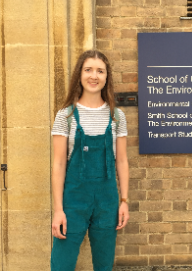
After a rigorous process, the winner is Abi Smith from the University of Cambridge. with her dissertation entitled:
Making sense of sonic affect: the automated voices of the London Underground
It was found that Abi’s dissertation was considered the overall winner given:
A clear and unique intellectual contribution to aural spaces and sonic geographies, demonstrating conceptual excellence and methodological originality. It was deemed by reviewers of publishable standard.
SCGRG dissertation prize committee
The winner receives £100 for the best undergraduate dissertation while the runner-up and winner both receive a year’s personal subscription to the journal Social and Cultural Geography, published by Taylor & Francis.
The news of winning this award was equally as surprising as lovely to hear! I am hugely grateful to the SCGRG committee and to everyone- from the voiceover artists and LUUs (London Underground Users) to my Director of Studies supervisors, and accessibility team- who both inspired and made completing this dissertation possible.
Abi Smith
We are delighted that Abi has taken out the time to write a blog post for us, where she highlights her motivations for doing the research, her passion for sonic geographies and her reaction to being our winner.
Influences and motivations for the research
The broad and exciting nature of Geography quickly became clear, and this only made the process of narrowing down a dissertation topic more difficult. Whilst I found the many dimensions of sensory geographies particularly intriguing, it wasn’t until after several discussions with my Director of Studies, and a sensory methods lecture, that I began to realise that these ideas could form the basis for my dissertation.
During the process of exploring these themes for my research proposal, I came across an article by Nina Power examining the prolific use of female-sounding voices in urban space. The article not only raised many important questions but led me to realise that there were several empirical gaps relating to the study of automated voices, and sound, within Geography. To build on these questions, I decided to centre my focus on the London Underground, both due to my own familiarity with the network and its geographical significance.
The Sounds of the Underground: Research methods
By focusing specifically on the carriage space, my dissertation attempts to respond to calls within sonic geography to better conceptualise the relationship between sound and affect. Combining interviews with the voices of the well-known ‘Mind the Gap’ announcements, sound recordists, and London Underground users (LUU) with phonographic methods, it considers the sonic design, and reception of, automated announcements through the lens of affect. To do so it employs an ‘expanded euphonics’ to overcome the limitations of previous methodological, empirical and theoretical approaches, which typically emphasise sight and overlook the intricate processes of sound-making. Primarily drawing on the work of Gernot Böhme and Michael Gallagher, this expanded euphonics sought to (i) centre the sonic, (ii) understand how sonic atmospheres are designed and perceived and (iii) counteract the ocular-centrism which often persists in studies of affects and atmospheres. Methodologically, this involved collecting several audio recordings (remotely), incorporating these recordings within the interviews, and then utilising interview recordings within the text itself to invite the reader/listener to reflect on their own embodied reactions.
Contributions to sonic geographies
Moving beyond the visible components of the carriage previously researched, attending to the sonic revealed that these voices have a unique capacity to affect LUUs. Yet, it similarly demonstrated that this capacity is impinged upon by numerous external influences. Such influences ensured that whilst attempts to alter and/or design sonic affects (through the control of voice’s gender, tone, accent) are to some extent successful, unpredictable affective encounters persist- many of which were not possible to explore within the dissertation.
Reflections and future research
Whilst I was initially hesitant about how this process would work, considering the covid restrictions, I enjoyed finding alternative ways to examine these voices remotely (and found the SCGRG website particularly useful for this!). Although I had always planned to use audio recordings, the travel restrictions meant that they proved vital for evoking memories and a sense of place. Even though Zoom interviews took some getting used to, the virtual context also had many benefits, such as being able to contact a much wider range of people. Ultimately, this process demonstrated to me that there is huge potential for further research not only into automated voices, but within sonic geography more broadly.
We’re very much looking forward to the upcoming RGS-IBG 2021 conference and our sponsored sessions. Information with links to our sponsored sessions can be found below:
Wednesday 1st September
9.00 – 10.40 BST
##conf1115 Imagined, imaginative, and imaginary geographies (1)
I wanted to study Geography at University to have the opportunity to delve deeper into this diverse, interdisciplinary subject; I was especially drawn to the emphasis placed on the complex interconnections between the human and more-than-human world. I crucially believed (and still believe!) that Geography provides the most useful, interesting, and productive lenses through which to better understand and critically analyse societies and environments.
Your dissertation focuses on rights to the city and urban citizenship in a Barcelona ‘superblock’. What is a ‘superblock’ and what led you to study these issues around it for your project?
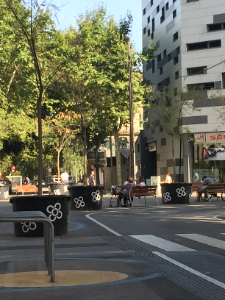
A superblock is an urban planning intervention being developed by a public consortium – BCNecologia – that aims to prioritise the needs of people over cars in contemporary cities. I first came across this initiative in an A Level Geography class where we were discussing novel ways in which cities are becoming more sustainable. Since I wanted to incorporate my Spanish into the dissertation process and had been fascinated by the project, I decided it would provide an ideal research context.
Your dissertation was based on rich ethnographic fieldwork undertaken in just 2 weeks In Barcelona, and working across languages – could you tell us a bit about your experience of doing the research?
The most important thing is that I needed (and liked!) was to be very, very prepared – but also to make the most of unexpected aspects or opportunities as they arose in the field. At times, the thought of going to Barcelona to conduct interviews with people I had never met before was really daunting. But in the end, it was an incredibly exciting and enriching experience – perhaps the academic highlight of my degree. My time conducting research in Barcelona was absolutely unforgettable, especially since I met some incredibly kind, warm, insightful, and generous people; my research couldn’t exist without them.
What do you feel you learnt or gained from the dissertation process?
With the help of my supervisor, I grew to embrace the freedom to direct and develop my research in both more conceptually rooted and empirically significant ways. It was an amazing feeling to take an initial idea and run with it, from planning fieldwork logistics and reaching out to potential participants to conducting interviews, analysing transcripts, writing up findings, and re-drafting arguments over the course of a year.
Completing the dissertation also reaffirmed the importance of not letting self-doubt hold you back. I was unsure about the adequacy of my Spanish (from A Level) to conduct the interviews in the depth that I wanted and needed, but instinctively felt that I could do it since I had actively kept up the language since school. And after carrying out over 75 pre- and unarranged interviews in Spanish, I proved my point! It was amazing when interviewees complemented my Spanish and I was really proud of how rapidly I adapted to the context and become comfortable processing information and engaging with people in an open and professional way.
Do you have any advice for students currently thinking about studying Geography?
It can be helpful to check out the RGS-IBG Research Groups to see if the kinds of topics covered and research being conducted by members of the Groups interests you (since these are the kinds of academics who are likely to be lecturing and tutoring you at University). It’s really important to be proactive about your interests; try not to wait for a ‘light bulb’ moment but actively engage with the subject to see whether you want to pursue it further, remembering that it gets a lot more complex and multi-faceted – and interesting! – at University. Read a news article and think about how a Geographer might relate or respond to it, watch Geography talks and lectures on YouTube, find geographical podcasts, and look for suggested resources on University Geography Department websites. There’s so much out there once you start looking!
During my time at school I struggled to find a subject which I loved. I think in part this is due to the limited nature of a-level curriculums, but also due to the fact that I hadn’t realised that I need not love one subject, but many. Choosing geography was a long process, but once I began looking into the modules offered within my degree – “writing landscapes”, “space, place and sensory perception” and “gender and environment” to name but a few – I knew geography was the one for me. Not because it had exactly what I was looking for, nor because it led into a decisive career path, but because it offered me time, intrigue I knew I would have the most fun studying geography, and I think that sums it up.
How did you come to choose public art and memory as the focus for your dissertation?
I grew up on the outskirts of Harlow New Town, Essex, and have fond memories of the sculptures which sporadically appear in the post-war landscape of modernist social housing estates, roundabouts and green space. In a way my dissertation focus was incredibly personal. My own experiences and memories prompted me to discover the ways public art, landscapes and mundane life intersect in Harlow to create a unique lived experience both in the past and how these experiences actively inform life today, and into the future as the artworks and the town respectively change with time. Geography and the arts is somewhat a vast and yet unfulfilled project. I think this lies in academic geography’s interest in the subconscious aspects of everyday life – the ways we live without realising, which has trouble embracing that public artworks are the antithesis. They are almost always intentional in form and function. It is this tension I found perplexing, and is what made me delve into Harlow New Town’s public artworks.
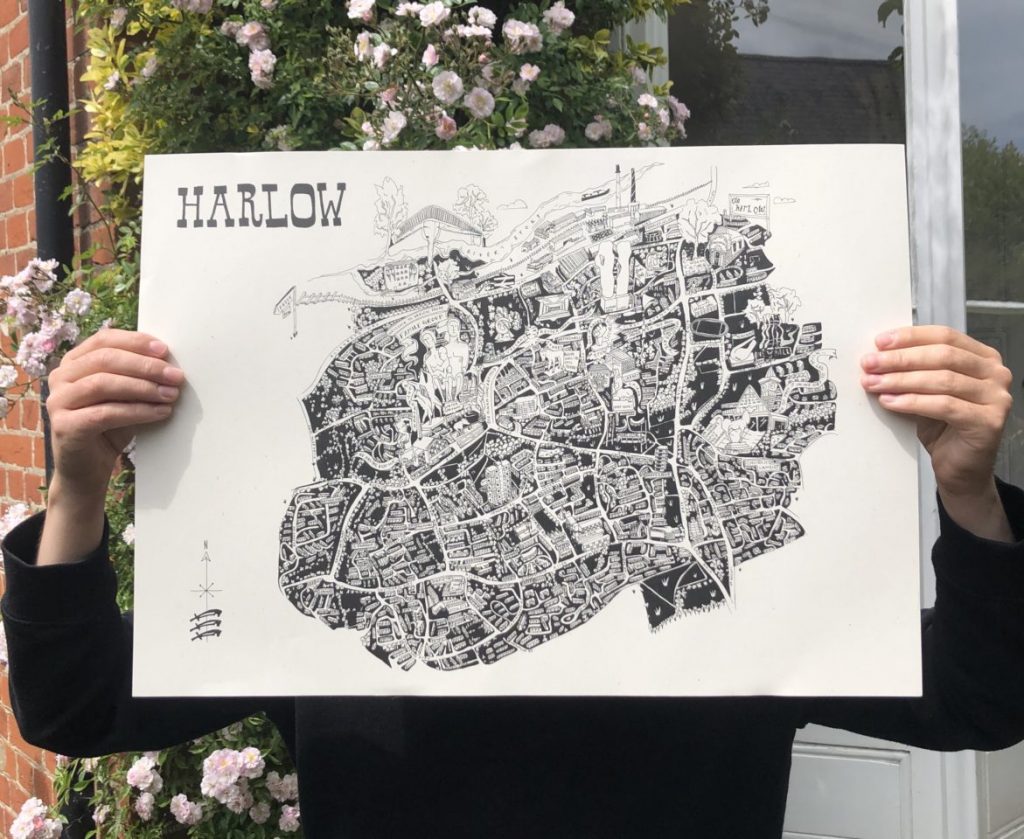
Your project takes a creative approach to the dissertation format, using narrative storying and illustrative map-making to present your findings – could you tell us a bit more about this approach, and your experiences of the walk-along interview method that formed the basis for your research?
The walk-along interviews are a technique which allowed participants to invite me into their hometown with control and connection to the surrounding landscapes. I was inspired by the political stance of feminist theorists such as Karen Barad and Stacy Alaimo, and wanted to incorporate a sense of radicalism to my method. It is only upon collecting my research did I see where this politics fitted in.
The participants during the walk-along method opened up more than I expected about their lives as they chose where we went and what they talked about. About grand schemes to sell a Barbra Hepworth sculpture to an American billionaire or the way the tactility of sculptures changed as time wore away at their surface. It is this relationship between place, agency and memories which allowed me to view space from a point of view which avoided casting landscapes as passive ‘backdrops’ to everyday life but instead how space and memory are entangled in environments where there is a syntax for reading space along a walk. The syntax I discovered during my research collection were the public artworks in Harlow. They worked as stepping stones linking memories between places and people. It was a pleasure to be able to explore the town countless times with residents, each exploring and using these stepping stones in a different order. In one sense my process was akin to reading the memories and landscapes in Harlow; public art as the language, and walking as the lines on a page connecting them together.
Because of this narrative ‘reading’ of space, I felt strongly my dissertation match my research style and take on a highly personal narrative format – four participants gaining their own chapters. The illustrated map was a means to undo the linearity of these antecedent narrative chapters. While storytelling works well in print, it fails to conjure up how complex and messy lived experience is in Harlow. The map is my attempt to record competing opinions of the sculptures and the town on one piece of paper, much inspired by Guy Debord’s deconstructions of seeing and being in urban space.
What do you feel you learnt or gained from the dissertation process?
My dissertation process was informed by the ways I thought I worked best. The emphasis here is on the fact I was unsure quite of what that meant, so I just gave myself time. I began my proposal in February 2019, then collected data in the summer. I found it highly useful to bite the bullet and collect data, as I wanted to avoid developing an argument before talking to participants. Around this time I knew I wanted to illustrate a map of the town by hand and was grateful for allowing myself room for adjust my timings. I began writing my dissertation and illustrating my map from October for an April deadline. Affording myself ample time to build relationships with participants, my supervisor and indeed get to know my material well was highly valuable. Above all, it is important to allow yourself time off, come back with fresh eyes and re-read and edit your work. Avoiding burnout, foregrounding commitment to your participants and rigour of research is a tricky balance, and I am still learning what that is, but staring your dissertation early is a good first step.
Do you have any advice for students currently thinking about studying Geography?
A piece of advice I have learned being a student is to research what your prospective lecturers study themselves. This is a great tip for finding out where geography can take you more widely, and the types of content you might expect from that lecturer’s courses. A good lecturer plays to their strengths and lectures around their own research perspectives, so make sure you choose a department you are interested in being a part of – it is a symbiotic relationship at degree level between teacher and student. Choosing geography is also a way to open countless doors to places, people and ideas. It sounds cliche, but geographers have a lot of fun together and it is an incredibly diverse and inclusive subject making it the perfect breeding ground for innovative research and exciting discoveries.
…and for Geography students who will soon be planning their dissertation research?
The dissertation is your opportunity to write the kind of work you wish you had read during your degree. It should be something which reflects your personality as much as your knowledge, if not more. Consequently, my advice is to be bold, committed and choose a topic which provokes a strong emotional response from yourself. And on a more practical note – keep a log of your sources as you go through the researching stages. You never know when you may need to retrace your steps to find a theory, quote or conceptual path to go down – It really is never too early to start a bibliography!
Eleanor Pendle of Oxford University is our 2020 Winner for her dissertation entitled ‘The Poblenou Superblock: Rights, Responsibilities and Exclusions‘. An engaging and detailed study of rights to the city, social justice, and urban citizenship in a Barcelona ‘superblock’, the panel were impressed by the study’s rigorous scholarship, nuanced analysis, and rich, in-depth fieldwork conducted across languages. The committee felt that this was an outstanding example of social/cultural geographical work.
The winner receives a prize of £100, and both have been given a one-year free subscription to the journal Social and Cultural Geography courtesy of Taylor & Francis.
In total we received 23 submissions for the prize this year from universities up and down the country, with work spanning the breadth of social and cultural geography. Many thanks to all students who submitted to the prize – we wish you all the best in your onward steps. We look forward to continuing the prize next year and await your submissions!
The 2020 AGM of the Social and Cultural Geography Research Group (SCGRG) took place online on Friday 4th September. Thank you to everyone who joined us!
We still have three committee vacancies available, which are as follows:
Dissertation Officer:
This post is a three-year term (in the first instance) and the role involves coordination of the dissertation prizes. The role involves advertising the Group’s dissertation prize through appropriate media, arranging the judging, liaising with the Treasurer and any sponsors in arranging the prize, conducting interviews with winner(s) and liaising with the website officer to display examples of winning entries from previous years. The role also involves sitting on the panel of the dissertation prize. The dissertation prize coordinator will usually be involved in SCGRG’s wider committee activities.
Postgraduate Representative:
This post is a one-year term (in the first instance) and the role involves liaising with the RGS-IBG Postgraduate Forum, engaging with postgraduate issues through our SCGRG postgraduate blog and working with our other postgraduate representative(s) on related events and activities. The PG representative would usually be involved in SCGRG’s wider committee activities, i.e. part of the judging panel for our undergraduate dissertation prize.
Conference officer:
This post is a key and important role for the group. The conference officer leads the coordination the group’s sponsorship and organisation of sessions at the RGS-IBG Annual Conference each year and other events and activities. The role involves compiling call for sessions proposals, liaising with session proposers, and organising the vote on the proposals by the committee. The conference officer would usually be involved in SCGRG’s wider committee activities i.e. part of the judging panel for our undergraduate dissertation prize.
Nominations for successors (who must normally be a Fellow or Postgraduate Fellow of the RGS-IBG) are now open. Nominations must be in writing to the Chair (Dr Tara Woodyer tara.woodyer@port.ac.uk) and Secretary (Dr Will Andrews w.andrews@bangor.ac.uk) with the name of two nominators (these need not be Fellows of the RGS-IBG or existing committee members).
If you have any questions about any of the above posts or about SCGRG more broadly, please email Tara and Will.
The 2020 AGM of the Social and Cultural Geography Research Group (SCGRG) will take place online on Friday 4th Sept 1100-1300 (BST). This year’s AGM will take place virtually, all are welcome to attend. Please encourage people who are not currently involved with the group to join us.
In accordance with RGS-IBG guidelines for digital security, anyone wishing to attend this year’s virtual AGM will need to register through Eventbrite prior to the event. The Zoom link for the AGM will be shared with you once you have registered.
We have six vacancies for Committee positions as current post-holders complete their terms of office:
* Secretary: This post is a three-year term (in the first instance) and the role involves coordination of the group’s administration. Each October the secretary prepares the annual report with the Chair and the Treasurer; the secretary also prepares agenda and notices for the AGM in July/August/September, and takes minutes of this (and any other) meeting(s). The secretary may attend the RGS-IBG Research Groups Committee at the RGS, normally in October and March. The secretary will usually be involved in SCGRG’s wider committee activities i.e. part of the judging panel for our undergraduate dissertation prize.
* Dissertation Officer: This post is a three-year term (in the first instance) and the role involves coordination of the dissertation prizes. The role involves advertising the Group’s dissertation prize through appropriate media, arranging the judging, liaising with the Treasurer and any sponsors in arranging the prize, conducting interviews with winner(s) and liaising with the website officer to display examples of winning entries from previous years. The role also involves sitting on the panel of the dissertation prize. The dissertation prize coordinator will usually be involved in SCGRG’s wider committee activities.
* Early career and Mentoring Officer: This post is a three-year term (in the first instance) and the role involves leading the research group’s mentoring and early-career related activities. The early career and mentoring officer will liaise with the education officer, the RHED officer of the RGS-IBG, and other research groups where appropriate, to coordinate the development of events and resources to support members. The early career and mentoring officer would usually be involved in SCGRG’s wider committee activities i.e. part of the judging panel for our undergraduate dissertation prize.
* Ordinary Committee Member (x 1): This post is a three-year term (in the first instance). Ordinary committee members would usually be involved in the SCGRG’s wider committee activities i.e. contribution to committee meetings and AGMs, being part of the judging panel for our undergraduate dissertation prize, reviewing conference session proposals, and contribution to research grant applications, medals and awards nominations, and research group events. Ordinary committee members may also be asked to provide support for named committee roles.
* Postgraduate Representatives (x 2): This post is a one-year term (in the first instance) and the role involves liaising with the RGS-IBG Postgraduate Forum, engaging with postgraduate issues through our SCGRG postgraduate blog and working with our other postgraduate representative(s) on related events and activities. The PG representative would usually be involved in SCGRG’s wider committee activities, i.e. part of the judging panel for our undergraduate dissertation prize.
Nominations for successors (who must normally be a Fellow or Postgraduate Fellow of the RGS-IBG) are now open. Nominations must be in writing to the Chair (Dr Tara Woodyer tara.woodyer@port.ac.uk) and Secretary (Dr Richard Scriven – r.scriven@umail.ucc.ie) with the name of two nominators (these need not be Fellows of the RGS-IBG or existing committee members). The deadline for nominations is Friday 28th August 2020. The elections will be conducted at the AGM itself, where details of nominations will be shared.
Further opportunities to be elected to a named role or as an ordinary committee member may become available during the AGM itself. We’ll also be discussing different ways that our wider membership can get involved with SCGRG.
If you have any questions about any of the above posts or about SCGRG more broadly, please email Tara and Richard.
Antonio Ferraz-de-Oliveira, from Cambridge University, has curated a document that was originally designed to support second year undergraduates, who are rapidly reformulating their dissertation plans for the summer. This project evolved into something quite substantial, and has been welcomed by PhD students and academics, who are also finding the need to revise and revisit research plans.
Antonio and other contributors have now released a version for general circulation, in the spirit of collective solidarity towards students, colleagues and researchers in these difficult times. You can find it following the link below: